
Battery Boosting in Edmonton: When to Call for a Jump Start
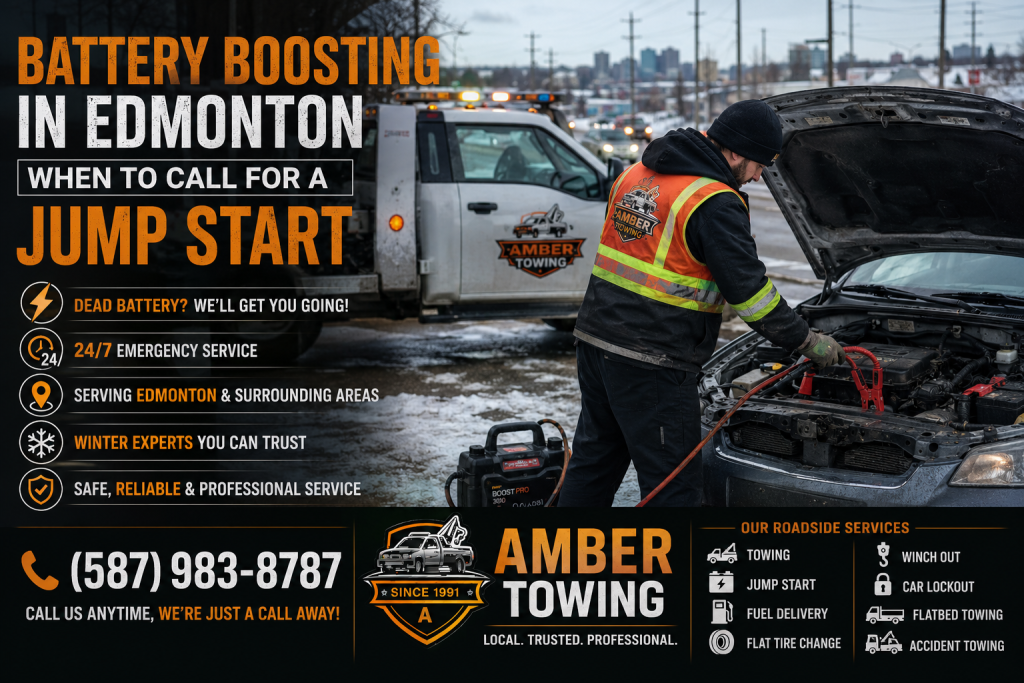
Battery Boosting in Edmonton is usually the right roadside solution when your vehicle has enough electrical power to start after receiving an external boost, but it is not the answer to every no-start problem. A weak battery, cold weather, interior lights left on, an aging battery, or an electrical issue can leave a vehicle unable to crank, even when the rest of the vehicle is mechanically sound.
If your car will not start, the most important question is not simply “Do I need a jump?” Is it safe to try a boost, and why did the car stop starting? In addition to towing and other roadside services, Amber Towing offers roadside help in Edmonton around-the-clock, including jump starts and battery boosting.
This guide explains how to recognise a likely dead battery, when to call for a professional jump start, what happens during a battery boost, why Edmonton winters can make battery problems worse, and when a boost should be replaced by a tow or mechanical diagnosis.
Why Battery Boosting Matters in Edmonton
A dead battery can turn an otherwise reliable vehicle into a roadside emergency. You may be sitting in a residential driveway in Mill Woods, outside a workplace in Southwest Edmonton, in a shopping-centre parking lot, or somewhere along a major route such as Anthony Henday Drive, Whitemud Drive, Yellowhead Trail, or Calgary Trail.
The situation becomes more serious when the vehicle stops in an unsafe location, at night, during heavy snow, or in extremely cold weather. Alberta recommends preparing vehicles for winter by checking the battery, tires, belts, hoses, brakes, heater and other essential components, while also carrying an emergency kit that includes booster cables.
A battery boost can be useful because it may solve the immediate starting problem without requiring Car Towing Edmonton. However, a successful jump start does not necessarily mean the battery is healthy. If the battery is old, damaged, repeatedly going flat, or the alternator is not charging correctly, the vehicle may stop again shortly after it starts.
That distinction is one of the most important things for a driver to understand: a boost can restore starting power, but it does not automatically repair the underlying battery or charging system.
What Is Battery Boosting and How Does a Jump Start Work?
Battery boosting is the process of supplying temporary electrical power to a vehicle with insufficient battery power to crank its engine. A professional roadside operator uses appropriate boosting equipment and connects it correctly to the vehicle’s electrical system before attempting to start the engine.
The goal is straightforward: provide enough electrical assistance for the starter motor to turn the engine. Although the state of the battery and charging system still needs to be taken into account, the vehicle’s charging system should generally start replenishing electrical energy once the engine begins.
A professional Jump Start in Edmonton is especially useful when the symptoms point toward a discharged battery rather than a major mechanical failure. Common examples include leaving headlights or interior lights on, leaving the vehicle unused for an extended period, or experiencing reduced battery performance during severe cold.
The important part is diagnosis before connection. A vehicle that has a damaged battery, serious electrical fault, incorrect battery installation, or another mechanical problem should not simply be repeatedly boosted without understanding the cause.
How to Tell If Your Vehicle Needs a Jump Start
The strongest sign of a discharged battery is usually a vehicle that does not crank normally when you turn the key or press the start button. You may hear rapid clicking, a single click, very slow engine cranking, or nothing at all. Interior lights and dashboard electronics may also appear unusually dim.
Another clue is that the vehicle worked normally before the incident but suddenly lost starting power. For example, if you accidentally left your headlights on overnight and the next morning the starter only clicks, a battery boost is a logical first response.
Cold weather can produce similar symptoms. A battery that is already weak may struggle much more when temperatures fall, which is why Edmonton drivers can experience no-start problems after an extremely cold night even when the vehicle was operating normally the previous day.
However, not every no-start situation is a battery problem. If the engine cranks strongly but refuses to start, the problem may involve fuel delivery, ignition, immobiliser systems, sensors, or another mechanical or electrical component. In that situation, repeatedly trying to boost the battery may not solve anything.
When You Should Call for Battery Boosting in Edmonton
You should consider calling for professional battery boosting when the vehicle shows clear signs of insufficient battery power and you cannot safely or confidently perform the procedure yourself. This is particularly sensible when you are alone, parked in an exposed location, dealing with winter weather, or driving a newer vehicle with complex electronic systems.
Professional assistance also makes sense when you do not know whether the vehicle uses a conventional 12-volt starting system or has specific manufacturer procedures for jump starting. Modern vehicles can have sensitive electronics, battery-management systems, remote-start equipment, auxiliary batteries, and other components that make improvising a roadside boost less desirable.
If you are on a busy roadway, safety takes priority over trying to diagnose the battery yourself. Move to a safe location if possible, activate your hazard lights, and avoid standing beside the vehicle where passing traffic creates a danger.
Alberta’s driver guidance stresses moving to a safe location when possible during a breakdown and using hazard lights when a vehicle is left in a potentially dangerous location.
When a Battery Boost Is Not the Right Solution
A jump start is not a universal fix for every vehicle that refuses to start. If the battery is physically damaged, leaking, swollen, frozen, or otherwise unsafe, attempting to boost it can create additional risk.
A boost may also be unsuccessful when the battery has an internal failure or is too deeply discharged to accept enough energy for starting. In other situations, the battery may start the vehicle but immediately fail again because the charging system is not functioning correctly.
If the engine cranks normally but does not fire, a battery boost may not address the actual problem. Similarly, unusual electrical smells, visible wiring damage, smoke, severe corrosion, or signs of a collision should be treated as reasons to stop experimenting and seek professional assistance.
This is where towing service edmonton can become more appropriate than roadside boosting. If the vehicle cannot be safely driven after assessment, a tow to a qualified repair facility may be the safer option.
What Happens When You Call Amber Towing for a Battery Boost?
When you contact Amber Towing, the useful information to provide is your exact location, vehicle type, symptoms, and whether the vehicle is in a safe parking position or exposed to traffic. The more accurate the information, the easier it is for dispatch to understand what kind of roadside assistance may be appropriate.
Amber Towing lists battery boosting and jump-start assistance as part of its 24/7 roadside services in Edmonton. The company also provides related services such as fuel delivery, flat tire assistance, car lockout help and winch-out recovery.
Once assistance arrives, the operator can assess the situation and determine whether a battery boost appears appropriate. If the vehicle starts successfully but the underlying problem appears unresolved, the next step may be further diagnosis, battery service, or towing rather than simply driving away and hoping the problem does not return.
That distinction can save time and prevent a driver from becoming stranded again several kilometres later.
Benefits of Professional Battery Boosting
The main benefit of professional boosting is that you do not have to rely on a stranger, an unsuitable set of jumper cables, or guesswork when your vehicle will not start. This is especially valuable in Edmonton during winter, when standing outside beside a disabled vehicle can quickly become uncomfortable or dangerous.
Another advantage is equipment. Professional roadside operators can arrive with purpose-built boosting equipment rather than relying on a random portable charger or another vehicle with an uncertain electrical setup.
Professional assistance can also identify when the problem is bigger than a discharged battery. A vehicle that repeatedly needs a boost deserves attention because repeated battery failure can point toward battery age, charging-system problems, parasitic electrical drain, poor connections, or another underlying issue.
For drivers who need more than a jump start, Amber Towing also provides Car Towing Edmonton, emergency towing and other roadside services, making it possible to move from a roadside boost attempt to vehicle transport when necessary.
How Much Does Battery Boosting Cost in Edmonton?
The cost of a battery boost varies between providers and circumstances. There is no single Edmonton-wide price because roadside pricing can depend on the provider, location, time, vehicle accessibility, service type, and whether additional work such as towing is required.
As a current public benchmark, Canadian Tire Roadside Assistance lists battery boosting at a starting price of $90 plus applicable taxes for its Edmonton roadside service. That should be treated as a reference point rather than a universal market price because independent towing companies and roadside programs use different pricing structures.
The best approach is to ask about the expected service charge before authorising the work. If the vehicle requires towing after an unsuccessful boost, confirm whether towing is priced separately.
A cheap towing service edmonton search can help locate lower advertised rates, but price should not be the only consideration during a roadside emergency. A low initial price is less useful if the provider cannot reach your location, does not have suitable equipment, or cannot safely handle your vehicle.
What Factors Can Affect the Price?
Distance is one potential factor because roadside operators have to travel to your location. A boost in central Edmonton may involve different dispatch requirements than assistance requested in Leduc, Beaumont, Nisku, Sherwood Park, or farther outside the city.
Vehicle access can also matter. A car parked in a normal driveway is straightforward compared with a vehicle inside a restricted underground parkade, behind another vehicle, on a narrow shoulder, or in an unsafe roadside position.
The service required can change the final cost as well. A simple boost is different from a situation that develops into Emergency Towing In Edmonton, accident recovery, winching, or transport to a repair facility.
For that reason, the most useful price question is not simply “How much is a jump?” Ask what the service includes, whether taxes or additional dispatch charges apply, and what happens financially if the vehicle cannot be started.
Common Reasons Edmonton Vehicles Need a Battery Boost
One of the most common causes is accidental electrical use while the engine is off. Headlights, interior lights, accessories, infotainment systems or other equipment can gradually drain a battery if the vehicle is left parked for long enough.
Age is another major consideration. Automotive batteries have a finite service life, and their ability to provide starting power can decline over time. A battery that has already shown signs of weakness should not be treated as permanently fixed simply because one jump start works.
Cold weather is particularly important in Edmonton. Low temperatures can reduce a battery’s ability to deliver starting power while simultaneously making the engine harder to crank. Alberta specifically recommends checking the battery as part of winter vehicle preparation.
Long periods of inactivity can also contribute to battery discharge. A vehicle that sits unused for weeks may gradually lose charge, particularly if it has systems that continue drawing small amounts of electrical power while parked.
Finally, a failing alternator or electrical drain can make a battery appear to be the problem when it is actually only the symptom.
Why Edmonton Winter Makes Battery Problems More Serious
Edmonton winters change the risk calculation. A dead battery in summer is inconvenient; a dead battery during a severe cold snap can become a safety issue, particularly if the vehicle is stranded away from shelter.
Alberta advises drivers to winterize their vehicles, check the battery and carry emergency supplies. During severe weather, the province also recommends avoiding unnecessary travel and checking road conditions before driving.
If your vehicle becomes disabled during a winter storm, staying with the vehicle may be safer than walking away from it in poor visibility or extreme cold. Alberta guidance for severe winter conditions specifically advises stranded motorists to remain with their vehicle and wait for assistance.
This is particularly relevant around major Edmonton routes where traffic can remain heavy even when visibility and road conditions deteriorate. Before winter travel, checking 511 Alberta for current road conditions and closures is a sensible precaution.
What Edmonton Drivers Should Do While Waiting for a Boost
If you are safely parked, keep the vehicle secured and use hazard lights when appropriate. If you are on or close to a high-speed roadway, do not stand unnecessarily beside the vehicle or attempt repairs in a dangerous traffic environment.
On roads such as Anthony Henday Drive, Whitemud Drive or Yellowhead Trail, traffic conditions can change quickly. Roadside workers themselves are protected under Alberta’s roadside-worker safety rules, so drivers should provide space and avoid creating additional hazards around stopped service vehicles.
During extreme cold, dress appropriately and keep your phone available for communication. If you are stranded in severe weather, the priority is remaining safe rather than repeatedly attempting to start the vehicle.
If you are inside a vehicle during a winter emergency and run the engine for warmth, make sure the exhaust pipe is not blocked by snow and allow appropriate ventilation. Alberta’s extreme-weather guidance highlights the danger of exhaust fumes and carbon monoxide when vehicles are stationary in snow.
Battery Boosting Versus Towing
Battery boosting and towing solve different problems. A boost is designed for a vehicle that is otherwise capable of starting and driving once sufficient electrical power is supplied. Towing is appropriate when the vehicle cannot safely or reliably continue under its own power.
For example, a car with a weak battery after its headlights were accidentally left on may only need a boost. A car with serious engine damage, brake problems, steering failure, major collision damage, or a persistent no-start condition may need towing instead.
Amber Towing provides both roadside assistance and towing, including Flatbed Towing Edmonton, which can be useful when a vehicle requires secure transport rather than another starting attempt. Its flatbed service is described for cars, SUVs, motorcycles, luxury vehicles and non-running or accident-damaged vehicles.
The practical rule is simple: if the vehicle can be safely returned to normal operation after the battery issue is addressed, boosting may be enough. If the vehicle remains unsafe, unreliable or mechanically disabled, towing is the better next step.
Expert Tips for Preventing Dead Battery Problems
The best time to think about your battery is before it fails. Pay attention to slow engine cranking, dimming lights, repeated starting difficulties and other changes in electrical performance.
Have the battery and charging system inspected if the vehicle repeatedly needs boosts. Replacing a failing battery before a major winter trip can be much less stressful than discovering the problem at a remote location.
Edmonton drivers should also prepare vehicles for seasonal conditions. Alberta recommends checking the battery and other critical components before winter and keeping an emergency kit in the vehicle.
If you regularly park outdoors during extreme cold, follow your vehicle manufacturer’s recommendations regarding block heaters and winter starting practices. The goal is not merely to make the vehicle start today but to reduce the chance of another no-start situation tomorrow.
Frequently Asked Questions
How do I know if I need battery boosting in Edmonton?
You may need battery boosting if your vehicle will not crank or only produces clicking sounds, especially when the lights and electrical accessories are weak or the battery was recently drained. Common causes include lights being left on, an aging battery, extended inactivity and cold weather. If the engine cranks normally but does not start, the issue may not be the battery. In that situation, professional roadside assistance can help determine whether a boost or towing is appropriate.
How much does a battery boost cost in Edmonton?
Battery boost pricing varies by provider, location, time, vehicle accessibility and the service required. As one current public reference, Canadian Tire Roadside Assistance lists battery boosting in Edmonton starting at $90 plus applicable taxes. Independent towing companies may use different rates, so it is best to confirm the expected charge before authorising service. If the vehicle cannot be started and requires towing, towing charges may apply separately.
Can a dead battery always be jump-started?
No. A battery may be too damaged, deeply discharged or otherwise unsafe to boost. The vehicle may also have another problem, such as a charging-system fault, electrical drain, starter problem or mechanical failure. A successful jump start also does not prove the battery is healthy. If your vehicle repeatedly needs boosts or stops again soon after starting, it should be inspected rather than repeatedly jump-started.
Is battery boosting safe for modern vehicles?
A professional boost can be appropriate for many modern vehicles, but the correct procedure depends on the vehicle. Modern cars can have sensitive electronic systems, battery-management components and manufacturer-specific jump-start points. Never assume that every vehicle should be connected in exactly the same way. If you are uncertain about the correct procedure, professional roadside assistance is safer than experimenting with jumper cables or unsuitable equipment.
What should I do if my battery dies on Anthony Henday Drive?
Your first priority should be safety, not the battery. If possible, move the vehicle to a safer position away from active traffic, turn on your hazard lights and contact roadside assistance. Avoid standing beside the vehicle unnecessarily. If weather or traffic conditions are hazardous, check 511 Alberta for current road information. Alberta also has specific protections for roadside workers, so drivers should provide stopped tow trucks and other roadside workers adequate space.
Can winter weather cause my car battery to die?
Yes. Cold weather can make starting more difficult and can expose weaknesses in an already aging or undercharged battery. Edmonton’s winter conditions make battery preparation particularly important. Alberta recommends checking your vehicle battery as part of winterization and carrying an emergency kit that includes booster cables. If your vehicle repeatedly struggles to start in cold weather, have the battery and charging system checked rather than waiting for a complete failure.
What if my car starts after a battery boost but dies again?
A vehicle that starts after a boost but soon stops or struggles to restart may have a battery that is no longer holding a sufficient charge, or it may have a charging-system or electrical problem. Do not assume that driving around for a few minutes has fixed the issue. If the vehicle does not appear reliable, arrange for appropriate roadside assistance or towing. A repeated no-start problem deserves diagnosis rather than repeated jump starts.
Can Amber Towing boost a battery in Mill Woods, Sherwood Park, Beaumont or Leduc?
Amber Towing identifies Edmonton and surrounding communities including Mill Woods, Sherwood Park, Beaumont and Leduc among its service areas. Its location pages describe roadside assistance that includes battery boosts along with other services such as tire changes, fuel delivery and lockout assistance. Exact response times can vary with traffic, weather, dispatch demand and your location.
Should I call a tow truck or request a battery boost?
Choose a battery boost when the symptoms strongly suggest a discharged battery and the vehicle otherwise appears safe to operate. Choose towing when the vehicle has significant mechanical problems, collision damage, an unsafe battery condition, repeated failed boost attempts, or another problem that makes driving unreliable or unsafe. Amber Towing provides both roadside assistance and towing, so the appropriate service can depend on what the operator finds at the vehicle.
What should I do if my car battery dies during an Edmonton winter storm?
Stay with the vehicle if you are stranded in a dangerous winter situation, particularly when visibility or temperatures are severe. Keep yourself warm, make your location known to the assistance provider and avoid unnecessary exposure outside the vehicle. If you run the engine for warmth, ensure the exhaust pipe is clear of snow and maintain appropriate ventilation because carbon monoxide can be dangerous. Alberta advises avoiding unnecessary travel during severe winter weather and checking current road conditions through 511 Alberta.
Conclusion
A dead battery does not automatically mean your vehicle needs a tow. In many cases, Battery Boosting In Edmonton can provide the immediate electrical assistance needed to start a vehicle and get the driver moving again. The important part is recognising when a boost is appropriate and when the no-start condition points toward a larger problem.
For Edmonton drivers, winter preparation is especially important. Check the battery before extreme cold arrives, pay attention to slow starts, keep an emergency kit in the vehicle and check road conditions before travelling during severe weather. Alberta recommends these precautions because winter conditions can quickly turn an ordinary vehicle problem into a safety issue.
If your vehicle is stranded with a dead battery, Amber Towing provides 24/7 roadside assistance and battery boosting in Edmonton, with additional support available when the problem requires towing or another roadside service.
For professional assistance, contact Amber Towing at (587) 983-8787 and provide your exact location, vehicle type and symptoms so the appropriate roadside solution can be arranged.