
What to Do After a Car Accident in Edmonton: Complete Towing & Recovery Guide
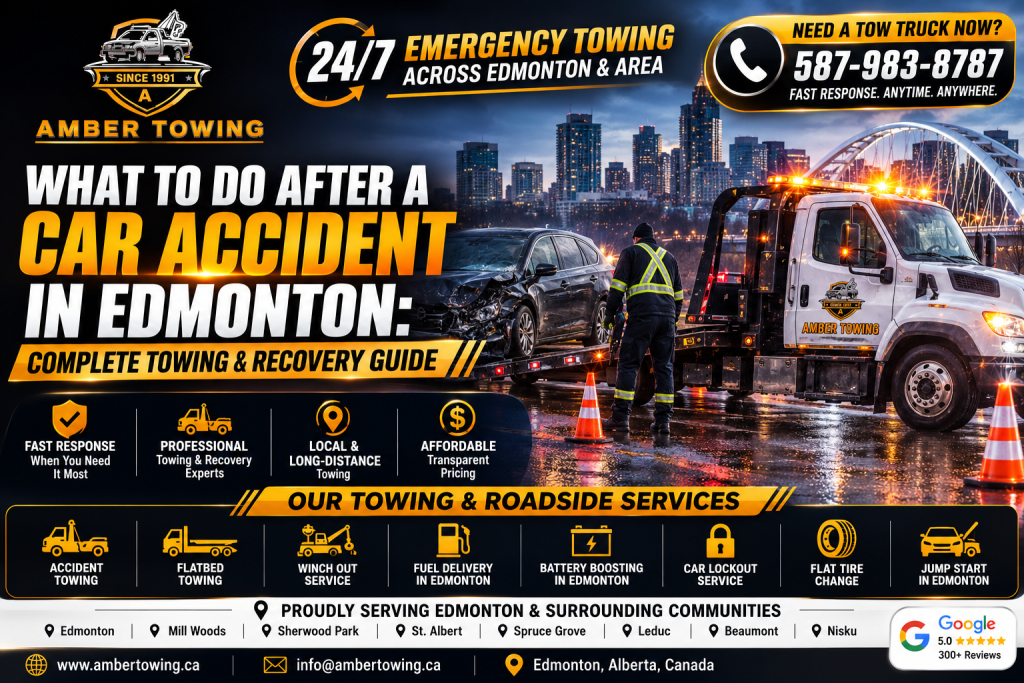
A Car Accident in Edmonton can leave you shaken, confused, and unsure what to do next. Whether a collision happens on Anthony Henday Drive, Yellowhead Trail, Whitemud Drive, Gateway Boulevard, or a residential street, the first priority is always safety. After that, you may need to deal with police, insurance, vehicle damage, collision reporting, and towing.
The safest approach is simple: protect people first, make the scene safe, document what happened, report the collision when required, contact your insurer, and arrange appropriate vehicle recovery if the car cannot be driven. Alberta’s official collision guidance confirms that drivers should not admit fault or make on-the-spot settlement promises, and that an undrivable vehicle must be removed from the roadway.
For drivers who need Accident Towing Edmonton services, Amber Towing provides 24/7 towing and roadside assistance throughout Edmonton and surrounding communities. Its services include accident recovery, car towing, flatbed towing, winch-out recovery and other roadside assistance options.
Why Knowing What to Do After a Car Accident in Edmonton Matters
The first few minutes after a collision can affect your safety, your vehicle, your insurance claim, and the amount of additional damage your car experiences. A damaged vehicle left in an active traffic lane can create a second collision risk, while attempting to drive a vehicle with damaged steering, suspension, wheels, brakes, airbags, or structural components can make the situation worse.
Alberta’s collision guidance recommends moving a driveable vehicle out of traffic when it is safe and there are no serious injuries. If the vehicle cannot be driven, hazard lights, warning triangles, cones, or flares can help make the scene more visible while arrangements are made to remove the vehicle.
This is especially important in Edmonton because road conditions can change quickly. Winter snow, black ice, blowing snow, reduced visibility, freezing temperatures, and heavy traffic on major routes can turn a relatively minor collision into a dangerous roadside situation.
After a car accident, what should you do right away?
The immediate priority after a collision is to check yourself and your passengers, assess the surrounding traffic, and call 911 when emergency assistance is required. Alberta advises calling 911 when someone is seriously injured or when you suspect a Criminal Code offence such as impaired driving.
Do not stand between damaged vehicles or walk into active traffic simply to inspect damage. If the vehicle is safely driveable, move it away from traffic when appropriate. If it is not driveable, turn on the hazard lights and move yourself and uninjured passengers to a safer location away from the roadway when possible.
Once everyone is safe, document the scene. Take photographs of the vehicles, damage, surrounding roadway, traffic signs, lane positions, road conditions, and anything else that may help explain what happened. Exchange the required contact and insurance information with the other drivers and record licence plate details.
Most importantly, avoid arguing about fault at the roadside. Alberta specifically advises drivers not to admit fault, make promises, sign statements, pay damages, or agree to an informal cash settlement immediately after a collision. Liability is handled through the appropriate insurance and legal processes.
When Should You Call 911 After an Edmonton Collision?
Call 911 when someone is seriously injured, when you suspect impaired driving or another serious offence, or when the circumstances require emergency police or medical assistance. If the collision creates an immediate danger to other road users, emergency assistance may also be appropriate.
A common misconception is that every minor collision requires an emergency 911 response. That is not necessarily the case. For a minor collision with no injuries or immediate danger, the appropriate reporting process may be different, so drivers should follow current Alberta and local police instructions rather than automatically treating every fender-bender as an emergency.
If you are uncertain about what to do, prioritizing safety and contacting the appropriate emergency or police service is better than trying to make a complicated decision while standing beside a damaged vehicle.
When Does a Car Accident Require Towing?
A vehicle generally needs towing when it cannot be safely driven away from the collision scene. There are other factors to take into account than visible damage. A vehicle may appear driveable while having damage to the suspension, steering, wheels, cooling system, exhaust, underbody, electrical systems, airbags, or other components that make continued driving unsafe.
Alberta’s official guidance states that when a vehicle is not driveable, arrangements must be made to remove it from the road.
This is where a professional towing service edmonton drivers can reach quickly becomes valuable. The tow operator can assess how the vehicle needs to be loaded and transported based on its condition, location, vehicle type, and destination.
Amber Towing provides accident towing and recovery for cars, SUVs, motorcycles, and light trucks and states that its equipment includes flatbed tow trucks and recovery equipment.
How Accident Towing Works After a Collision
Professional accident recovery is more than simply attaching a damaged car to a tow truck. The operator first needs to consider the vehicle’s position, traffic exposure, visible damage, wheels and tires, steering condition, and whether normal loading is possible.
For severely damaged vehicles, a flatbed may be appropriate because the vehicle can be transported on a level platform rather than relying on damaged wheels or drivetrain components. Amber Towing’s Flatbed Towing Edmonton service is intended for vehicles including cars, SUVs, motorcycles and accident-damaged or non-running vehicles.
If a vehicle has gone into a ditch, snowbank, soft shoulder, or another difficult position, recovery may require winching before transportation. Amber Towing also provides Winch Out Service Edmonton for vehicles stuck in snow, mud, ditches, or difficult roadside locations.
The destination should be discussed before the tow begins. Depending on the circumstances, the vehicle may need to go to a collision reporting facility, repair facility, body shop, storage location, dealership, or another agreed destination.
Selecting the Appropriate Tow Truck Following an Incident
Not every accident requires the same type of tow truck. A small sedan with rolling wheels may require a different loading method from a heavily damaged SUV, AWD vehicle, motorcycle, electric vehicle, or vehicle with locked wheels.
A flatbed is often a practical choice when the vehicle has significant damage, cannot roll normally, has sensitive drivetrain requirements, or needs additional protection during transport. The correct equipment should ultimately be determined by the vehicle’s condition and the towing operator’s assessment.
For ordinary vehicle transport, Car Towing Edmonton services can handle many standard passenger vehicles. For larger vehicles or more complex recoveries, the appropriate tow truck and recovery equipment should be confirmed with dispatch before the truck arrives.
What Are Your Towing Rights in Alberta in 2026?
Alberta introduced the Vehicle Towing and Storage Regulation effective April 1, 2026. The regulation is designed to give consumers clearer information and greater protection when paying for towing and storage services.
Under the regulation, towing operators generally must obtain consumer consent before towing or storing a vehicle unless an exemption applies, such as towing directed by law enforcement or another government authority. Operators must also provide a clear written estimate of towing and storage costs before the vehicle is towed.
The written estimate must identify the towing or storage costs and include required information about the person giving consent and the business. The final invoice must contain an itemized list of costs and other prescribed vehicle and service information.
The regulation also addresses vehicle transportation and access. Where mileage is charged, the operator generally must use the most direct route unless otherwise directed or agreed, and consumers must be notified if the vehicle is moved to another location. Consumers can also request access to personal belongings and inspection of the vehicle during business hours without charge, subject to the regulation’s conditions and exemptions.
These rules are particularly important after a collision because drivers are often stressed and may make decisions quickly. Asking for the written estimate, confirming the destination, and keeping your documentation can help you understand exactly what service you authorized.
How Much Does Accident Towing Cost in Edmonton?
There is no single price that applies to every accident tow in Edmonton. The final cost can depend on the distance, vehicle type, towing method, recovery difficulty, time or location of service, storage requirements, and whether additional recovery work is necessary.
A simple roadside tow is different from recovering a vehicle from a ditch after a winter collision. A damaged vehicle that requires specialized loading can also require different equipment from a car that can roll normally onto a flatbed.
Under Alberta’s 2026 towing regulation, businesses providing covered towing and storage services must provide a clear written estimate of applicable towing and storage costs before the tow, subject to the regulation’s exemptions.
If you are comparing cheap towing Edmonton options, do not look only at the lowest advertised number. A more useful comparison is the complete expected cost, the towing method, destination, storage arrangements, and what is actually included in the quoted service.
Is Accident Towing Covered by Insurance?
Accident towing may be covered by an automobile insurance policy, but coverage depends on the policy and circumstances of the collision. Drivers should contact their insurer as soon as reasonably possible and ask what towing, storage, rental vehicle, repair, and collision-related benefits apply to their specific policy.
Alberta advises motorists to notify their insurer after a collision regardless of which driver they believe was at fault. The province also notes that police do not determine insurance liability; liability is handled through insurance processes and, where necessary, the courts.
Do not assume that an insurance company will automatically cover every towing or storage expense. Ask your insurer where the vehicle should go, what documentation is required, and whether you have any coverage limits or preferred procedures.
Amber Towing states that it can work with insurance providers or provide an invoice that customers can use for reimbursement, depending on the circumstances and applicable coverage.
What If Your Vehicle Is Towed Before You Contact Your Insurance Company?
If your vehicle has already been removed from the collision scene, contact your insurance company promptly and provide the location of the vehicle, the towing information, and the collision details. Keep the tow estimate and final invoice because these documents may be relevant to your claim.
Alberta recommends contacting your insurer after reporting the collision and providing details about injuries, vehicle damage, and property damage.
If you do not know where your vehicle was taken, ask the towing operator for its current location. Alberta’s towing regulation also requires operators, in covered circumstances, to notify the owner if the vehicle is moved to another location.
Collision Reporting in Edmonton
Collision reporting requirements depend on the circumstances. Alberta’s current guidance states that police reporting is required when someone is injured, when a driver lacks required documentation, when one or more vehicles are not driveable, or when combined vehicle damage reaches the $5,000 threshold.
The province confirmed that the $5,000 Property Damage Collision threshold remains unchanged for 2026.
If your vehicle cannot be driven after a collision, arranging suitable transportation is therefore an important part of completing the post-accident process. A professional Tow Truck in Edmonton can transport the vehicle when driving it would be unsafe or impossible.
Drivers should rely on current Alberta and Edmonton Police Service instructions for the correct reporting location and process because collision-reporting procedures can change. Do not rely on an old blog post or advice from another driver when official instructions are available.
What Should You Tell the Towing Company?
When contacting a towing company after an accident, give the dispatcher as much useful information as possible without putting yourself in danger. The exact location is important, but so are the direction of travel, nearby intersection, highway exit, vehicle type, vehicle condition, whether the wheels roll, and whether the vehicle is in a ditch or blocking traffic.
For example, saying that your SUV is disabled on the right shoulder near a specific Anthony Henday exit is more useful than simply saying you are somewhere on the Henday. If you are on Yellowhead Trail, Whitemud Drive, Calgary Trail, or another major route, provide the nearest exit, intersection, landmark, or kilometre information you can safely identify.
Tell dispatch if the vehicle has major front-end damage, damaged wheels, deployed airbags, leaking fluids, locked wheels, or other obvious problems. This helps the towing company determine what equipment may be appropriate before sending a truck.
Edmonton Roads and Locations Can Change the Recovery Approach
A collision in downtown Edmonton can present different recovery challenges from one on Anthony Henday Drive or Highway 16. Traffic volume, lane configuration, shoulder width, construction, road visibility, and access for the tow truck can all affect the recovery process.
In Mill Woods, for example, accident or breakdown recovery may involve busy arterial roads such as 23 Avenue and 50 Street, while collisions around Sherwood Park can involve major connecting routes and highway traffic. Amber Towing provides towing services in Edmonton and surrounding communities including Mill Woods Towing, Sherwood Park Towing, Beaumont and Leduc.
Drivers travelling between Edmonton and communities such as Nisku, Leduc, Beaumont, Sherwood Park, St. Albert, or Spruce Grove should provide the most precise location possible when requesting roadside help. A clear location reduces unnecessary confusion during an already stressful situation.
Winter Car Accidents in Edmonton Require Extra Caution
Edmonton winters can make accident scenes considerably more dangerous. Snow-covered roads, ice, black ice, freezing temperatures, blowing snow, poor visibility, and reduced daylight can increase the risk of a secondary collision while you wait for assistance.
If your vehicle is disabled during winter, remain visible and move yourself and passengers away from moving traffic when it is safe. Keep warm while waiting and avoid standing behind or between vehicles.
A vehicle stuck after a collision may also require more than a conventional tow. Snow around the tires, a ditch, or an unstable shoulder can make winching or specialized recovery necessary. Amber Towing offers Emergency Towing Edmonton and winch-out assistance for urgent roadside situations.
Common Mistakes to Avoid After an Accident
One of the most common mistakes is assuming that a vehicle is safe to drive simply because the engine starts. Collision damage can affect components that are not immediately visible, so a professional assessment may be safer than driving the vehicle to a repair shop.
Another mistake is accepting an informal cash settlement before understanding the extent of the damage. Alberta specifically advises drivers not to accept money, promise payment, or agree to settle the collision at the scene.
Drivers should also avoid signing documents they do not understand, choosing a destination without confirming it, or agreeing to towing costs without reviewing the required estimate. Alberta’s 2026 towing regulation makes written cost information an important part of covered towing transactions.
Finally, do not focus so heavily on vehicle damage that you forget about personal safety. A scratched bumper is less important than standing in an active traffic lane during Edmonton rush hour or a winter storm.
Professional Advice for Choosing Accident Towing
The best towing decision after a collision is not necessarily the fastest truck with the lowest advertised price. Look for clear communication, appropriate equipment, transparent pricing, a confirmed destination, and an operator who understands that a damaged vehicle may require a different loading method from a normal breakdown tow.
Before the truck arrives, confirm what you are authorizing and where the vehicle is going. Keep a copy of the estimate and later retain the itemized invoice for your records.
If your vehicle needs to travel across Edmonton or outside the city, ask about Local and Long-Distance Towing before the tow begins. Amber Towing offers both local and long-distance vehicle transport as part of its towing services.
When Towing Is Not the Right Solution
Not every roadside problem after an incident requires a tow truck. If your vehicle is safe and the problem is unrelated to collision damage, a roadside service may solve the issue without transporting the vehicle.
For example, a dead battery may only require Battery Boosting In Edmonton or a Jump Start in Edmonton. A flat tire may require a tire change, while keys locked inside the vehicle may require Car Lockout Service Edmonton. Running out of fuel may be resolved through Fuel Delivery in Edmonton.
However, after an actual collision, do not attempt a roadside repair simply to avoid towing if the vehicle may have structural or mechanical damage. Safety should determine whether the vehicle is driven, repaired at the roadside, or transported.
How to Prepare Before Your Next Edmonton Collision
The easiest accident to manage is the one you have prepared for. Save your insurer’s claims number and a reputable local towing company’s contact information in your phone before you need them.
It is also useful to keep a phone charger, flashlight, reflective equipment, warm clothing or blankets, water, and basic winter emergency supplies in your vehicle. Alberta recommends keeping a collision worksheet in the glove compartment so drivers can record important information after an accident.
Knowing your insurance coverage is equally important. Before an accident occurs, find out whether your policy includes collision coverage, towing, roadside assistance, storage, rental vehicle benefits, and any restrictions on repair facilities or transportation.
Frequently Asked Questions About Car Accidents in Edmonton
What should I do first after a car accident in Edmonton?
After a collision, check for injuries and immediate danger first. Call 911 when someone is seriously injured or when emergency police assistance is required. If the vehicle is driveable and it is safe to do so, move it out of traffic; if it cannot be driven, activate hazard lights and move to a safer location away from traffic when possible. Then exchange information, document the scene, follow applicable reporting requirements, contact your insurer, and arrange towing if necessary.
Do I have to call the police after a car accident in Edmonton?
Police reporting depends on the circumstances of the collision. Alberta says reporting is required when someone is injured, a driver lacks required documentation, one or more vehicles are not driveable, or combined vehicle damage reaches $5,000 or more. Certain damage to public property also requires reporting regardless of the dollar amount. Always follow current Alberta and Edmonton Police Service instructions for your specific collision.
Can I choose my own towing company after an accident in Alberta?
Alberta’s towing rules changed on April 1, 2026, introducing consumer protections around consent, estimates, invoices, transportation, and vehicle access for covered towing and storage services. However, exemptions apply, including certain situations where towing is directed by law enforcement or another government authority. If you are free to arrange your own tow, confirm the towing company, price estimate, and destination before authorizing service.
How much does accident towing cost in Edmonton?
Accident towing prices vary depending on the distance, vehicle, towing equipment, recovery difficulty, time and location, and whether storage is required. A vehicle recovered from a ditch or transported with specialized equipment can cost more than a straightforward local tow. Alberta’s 2026 towing regulation requires covered towing businesses to provide a clear written estimate of towing and storage costs before the tow begins, subject to applicable exemptions.
Should I drive my car after a collision if it still starts?
Starting does not mean a collision-damaged vehicle is safe to drive. Damage to steering, suspension, wheels, brakes, airbags, cooling systems, drivetrain components, or the vehicle structure may not be obvious immediately. If there is significant damage, warning lights, fluid leakage, wheel damage, unusual steering, or uncertainty about roadworthiness, arranging Accident Towing Edmonton service is safer than taking the vehicle onto Edmonton traffic.
Does insurance pay for towing after an accident?
Towing coverage depends on your automobile insurance policy and the circumstances of the collision. Alberta recommends notifying your insurer as soon as possible after a collision and discussing the damage and available coverage. Before authorizing additional storage or transportation, ask your insurer what is covered, where the vehicle should go, and what receipts or invoices you need to keep for your claim.
Should I accept cash from the other driver at the accident scene?
It is better not to make an informal settlement at the roadside. Alberta advises drivers not to accept money, make promises, pay damages, admit fault, or agree to forget the collision. Vehicle damage may be more extensive than it initially appears, and insurance and liability decisions should be handled through the appropriate process rather than an immediate roadside agreement.
When is flatbed towing better after a collision?
Flatbed towing can be particularly useful when a vehicle is heavily damaged, cannot roll normally, has drivetrain concerns, has damaged wheels, or needs additional protection during transportation. The appropriate method depends on the vehicle and its condition. Amber Towing provides flatbed transportation for accident-damaged and non-running vehicles as well as cars, SUVs, motorcycles and other vehicles.
What information should I give a towing company after an accident?
Give the dispatcher the precise location, vehicle make and model, whether the vehicle can roll, visible damage, traffic conditions, and your intended destination if known. Mention damaged wheels, deployed airbags, fluid leaks, a ditch or snowbank, or any other condition that could affect loading. On roads such as Anthony Henday Drive or Yellowhead Trail, provide the nearest exit, intersection, direction of travel, or other identifying landmark whenever safely possible.
What should I do if my car is stuck after an Edmonton winter accident?
Do not repeatedly spin the wheels or attempt aggressive manoeuvres if the vehicle is damaged or trapped in snow. Turn on hazard lights, remain visible, and move away from traffic when safe. If the vehicle is in a ditch or deep snow, professional winching or recovery may be safer than trying to pull it out yourself. Amber Towing provides winch-out recovery for vehicles stuck in snow, mud and roadside ditches.
Conclusion: What to Do After a Car Accident in Edmonton
A Car Accident in Edmonton does not have to become more stressful because you are unsure what to do next. Focus on safety first, call emergency services when required, move a driveable vehicle away from traffic when safe, document the collision, exchange information, follow Alberta’s reporting requirements, notify your insurer, and arrange appropriate towing when the vehicle cannot be safely driven.
For accident recovery, the towing decision matters because the wrong equipment, destination, or rushed agreement can create unnecessary problems later. Alberta’s towing regulations now provide additional consumer protections around consent, written estimates, invoices, vehicle location, transportation and access for covered towing and storage services.
Amber Towing provides 24/7 accident recovery, towing and roadside assistance across Edmonton and surrounding communities, including Mill Woods, Sherwood Park, Beaumont and Leduc.
When a collision leaves your vehicle unsafe or unable to move, professional Edmonton towing can help get the vehicle to the appropriate destination while you focus on the people, reporting, insurance, and next steps that matter most.