
Edmonton Winter Driving Emergency Kit: What Every Driver Should Carry
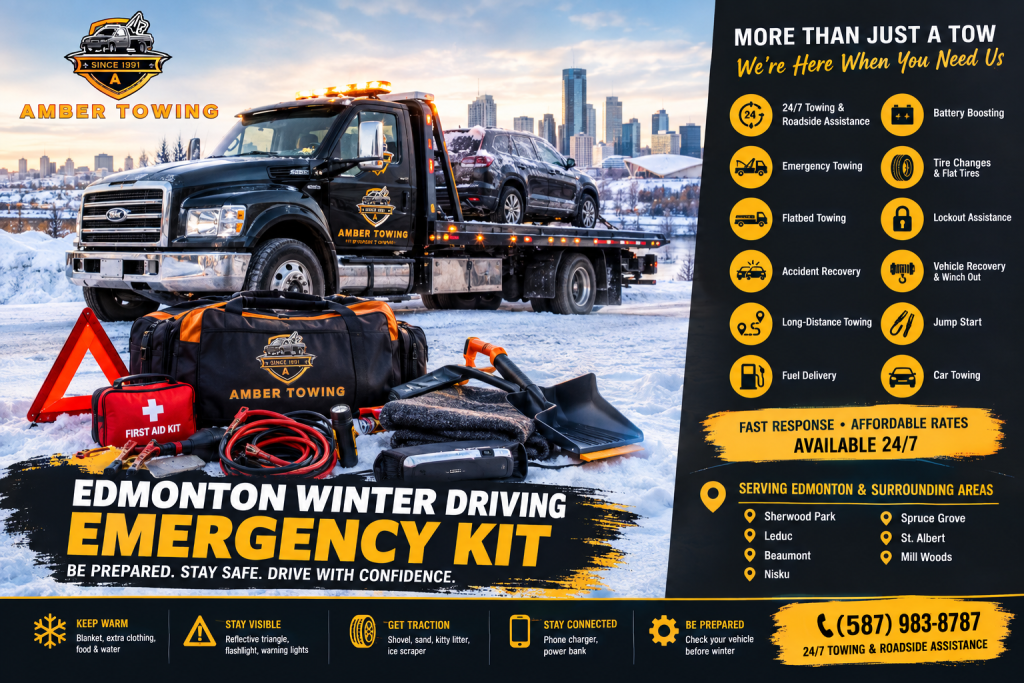
Edmonton winter driving can turn an ordinary commute into a roadside emergency with very little warning. Snow, ice, freezing temperatures, poor visibility, dead batteries, flat tires and vehicles stuck in snow can all create problems even when a vehicle was running normally minutes earlier. A properly prepared winter driving emergency kit gives Edmonton drivers the basic equipment needed to stay warm, improve traction, remain visible and call for help safely when conditions deteriorate.
Why an Edmonton Winter Emergency Kit Matters
An Edmonton winter emergency kit is designed to keep you safe while you wait for conditions to improve or roadside assistance to arrive. It is not intended to replace professional recovery or mechanical repairs. Its purpose is to give you enough warmth, visibility, communication and basic equipment to manage the first part of an unexpected roadside situation.
Transport Canada recommends carrying items such as a small shovel, traction material, warning devices, warm clothing, food, water, booster cables, windshield washer fluid and basic tools. Alberta also recommends carrying an emergency kit and preparing your vehicle for winter conditions, including checking tires, the battery, brakes, heater, defroster, wipers and antifreeze.
This matters particularly in Edmonton because winter conditions can change quickly. A vehicle can become difficult to move after getting stuck in packed snow, while a minor breakdown can become a much more serious problem when temperatures are extremely low. The City of Edmonton also recommends keeping winter-specific supplies such as extra clothing, a blanket, shovel, traction material, a first aid kit, booster cables, a flashlight, food and water in the vehicle.
What Should Be in an Edmonton Winter Driving Emergency Kit?
The most important items are the ones that address four immediate problems: staying warm, being seen, getting unstuck and contacting help. Your kit should therefore contain a warm blanket, extra winter clothing, gloves, a toque, warm socks, suitable footwear, a flashlight with spare batteries, a first aid kit, non-perishable food, drinking water, a phone charging cable or power bank, booster cables, an ice scraper, snowbrush, small shovel and a bag of sand, salt or non-clumping kitty litter.
Transport Canada specifically recommends supplies including a shovel, traction mats or kitty litter, warning lights or reflective triangles, extra clothing, food, water, booster cables, hand and foot warmers, windshield washer fluid, lock de-icer and a basic tool kit. Canada.ca also recommends a blanket, extra clothing and shoes, a first aid kit, shovel, scraper, snowbrush, flashlight, whistle, roadmaps, traction material, jumper cables and warning devices.
Do not forget items that are easy to overlook. A spare tire should be properly inflated if your vehicle uses one, and the jack and lug wrench should actually be present. A phone can become your most important emergency tool, but a nearly empty battery is not useful when you are stranded, so keep a charging cable and power bank available.
Keep Some Emergency Supplies Inside the Cabin
One useful improvement over a traditional trunk-only emergency kit is to divide your supplies between the trunk and passenger area. Keep your shovel, traction material, booster cables and other equipment in an accessible location, but keep a small emergency pouch inside the cabin containing a blanket, gloves, warm hat, snacks, flashlight and phone charger.
This arrangement matters if your vehicle is involved in a collision, the trunk becomes inaccessible or snow prevents you from safely opening it. Michelin Canada similarly recommends keeping core recovery equipment in the vehicle while maintaining a smaller winter survival pouch within reach of the occupants.
If you become stranded in severe weather, staying warm and communicating with help can be more important than attempting a difficult roadside repair. Your emergency kit should support that decision rather than encourage you to take unnecessary risks.
How to Prepare Your Vehicle Before Edmonton Winter Arrives
An emergency kit is only one part of winter preparation. Alberta recommends checking tires, the spare tire, battery, belts and hoses, antifreeze, brakes, heater, defroster and windshield wipers before winter driving becomes routine. Alberta also recommends considering winter tires because they are designed for low temperatures and snowy or icy conditions.
Visibility deserves special attention. Before driving, clear snow and ice from the windshield, windows, mirrors, headlights, taillights and licence plate. Snow left on the roof can also become a visibility or road-safety problem once the vehicle starts moving.
Windshield washer fluid should be suit able for sub-freezing conditions. Carrying an extra container can be useful during periods of heavy road spray and repeated cleaning. Your battery also deserves attention because cold temperatures can make starting more difficult, particularly when the battery is already weak.
Fuel planning is another overlooked part of winter preparation. Alberta recommends keeping the fuel tank more than half full during winter, while federal guidance also recommends keeping adequate fuel during severe weather.
What to Do If Your Vehicle Gets Stuck in Snow
If your vehicle becomes stuck, avoid immediately spinning the wheels aggressively. Excessive wheelspin can dig the tires deeper into snow and make recovery more difficult. Turn on your hazard lights, assess your surroundings and determine whether the vehicle can be moved safely without exposing you to traffic or unstable ground.
A small shovel can help clear snow around the tires, while sand, non-clumping kitty litter or traction mats can provide additional grip. These tools are intended for situations where the vehicle is lightly stuck and recovery can be attempted without putting people at risk.
If the vehicle is deeply stuck, sitting in a ditch or positioned where traffic creates a danger, professional vehicle recovery is the safer choice. Amber Towing specifically provides winch-out service in Edmonton for vehicles stuck in snow, mud or roadside ditches, using recovery equipment designed for extraction.
The important distinction is between a vehicle that needs a little traction assistance and a vehicle that requires controlled recovery. If there is significant resistance, unstable ground or risk of vehicle damage, continuing to accelerate usually makes the situation worse.
When a Winter Emergency Requires Professional Roadside Assistance
Not every winter problem requires a tow truck. A dead battery may require a battery boost, a flat tire may require a tire change, a locked vehicle may require lockout assistance and an empty fuel tank may require fuel delivery. Choosing the appropriate roadside service can save time and may avoid an unnecessary tow.
Amber Towing lists battery boosting, flat tire changes, fuel delivery, car lockout assistance and winch-out recovery among its Edmonton roadside services. Its emergency towing service also covers breakdowns, accidents and other urgent roadside situations.
A vehicle that cannot safely continue should be treated differently from a vehicle that simply needs a minor roadside fix. If the vehicle has collision damage, steering or braking problems, significant mechanical failure or a dangerous roadside position, towing may be the appropriate option.
Edmonton Roads Require Extra Winter Awareness
Winter preparation becomes particularly important around major Edmonton traffic corridors and busy routes where a breakdown or collision can expose occupants to moving traffic. Drivers may encounter snow-packed surfaces, icy intersections, reduced visibility and rapidly changing traction conditions.
Road conditions can also differ between residential streets and major routes. A road that appears clear may still have icy sections around intersections, bridges, ramps and shaded areas. Alberta advises drivers to stay off the road when winter storms make travel unnecessary and not to travel when roads are officially closed.
Before travelling, checking weather and road conditions can help you decide whether the trip is necessary. 511 Alberta provides information about Alberta highway conditions and snowplow operations, and Alberta advises drivers to exercise additional caution during poor winter weather.
Edmonton-area drivers travelling toward Sherwood Park, Leduc, Beaumont, Nisku, Spruce Grove, St. Albert or Mill Woods should also consider the distance they may need to travel before reaching their destination. A winter emergency kit becomes increasingly valuable when a breakdown occurs away from home or during a severe weather event.
What to Do If You Break Down on a Winter Road
If your vehicle becomes disabled, your first priority should be getting yourself and your passengers into the safest possible position. If the vehicle can be moved safely away from traffic, do so. Turn on hazard lights and make the vehicle as visible as possible.
If the vehicle cannot be moved safely, remain aware of surrounding traffic and contact the appropriate emergency or roadside service. Transport Canada recommends keeping a fully charged phone and contacting 911 in an emergency.
Do not assume that because you are inside Edmonton you can safely walk a long distance to find assistance. Extreme cold, poor visibility and traffic can make leaving the vehicle more dangerous than waiting for help. If you are stranded, conserve phone battery, keep warm and communicate your exact location as clearly as possible.
Your location description should include the road or street name, nearest intersection, direction of travel and any recognizable landmark. If you are on a major road such as Anthony Henday Drive, Whitemud Drive or another busy route, provide the direction and nearest exit or interchange whenever possible.
Winter Emergency Kit Mistakes Edmonton Drivers Should Avoid
One of the most common mistakes is owning an emergency kit but never checking it. Batteries can lose charge, food can expire, water can freeze, clothing can be removed for everyday use and tire pressures can fall. Canada.ca recommends reviewing emergency supplies regularly and updating seasonal items.
Another mistake is carrying only mechanical equipment. A shovel and booster cables may help with the vehicle, but they do nothing to keep passengers warm if the wait becomes prolonged. A blanket, winter clothing, water, food, flashlight and communication equipment are equally important.
Some drivers also rely completely on smartphone navigation. Digital maps are extremely useful, but a paper map can provide a backup when the phone battery is depleted or connectivity becomes unreliable. Federal and provincial emergency-preparedness guidance continues to recommend keeping maps or other navigation backups.
Finally, do not treat a winter emergency kit as permission to perform repairs beyond your experience. The purpose of the kit is to improve safety and help with basic situations. If the vehicle requires specialized recovery or towing, professional help is usually the better decision.
How Much Does Winter Roadside Assistance Cost in Edmonton?
There is no single winter towing price that applies to every roadside emergency. The final cost can depend on the service required, vehicle type, location, distance, recovery difficulty, equipment needed and whether the vehicle can be handled with roadside assistance or requires towing.
A simple battery boost and a difficult snow recovery are fundamentally different jobs. Similarly, towing a small passenger vehicle locally is different from recovering a damaged vehicle after a collision or arranging a longer-distance transport.
Before authorizing service, ask what service is being dispatched, what pricing applies and whether additional recovery or mileage charges may affect the final amount. Amber Towing states that it provides transparent pricing and handles towing and roadside assistance throughout Edmonton and surrounding communities.
If insurance, a roadside membership such as CAA or AMA, or another assistance program may cover part of the service, confirm the coverage and any limitations before assuming the entire cost will be reimbursed.
When Should You Call Amber Towing?
Amber Towing provides 24/7 towing and roadside assistance in Edmonton and lists emergency towing, accident recovery, car towing, flatbed towing, local and long-distance towing, fuel delivery, battery boosting, flat tire changes, car lockout assistance and winch-out recovery among its services.
Winter-specific situations where professional assistance may be appropriate include a vehicle deeply stuck in snow, a vehicle involved in a collision, a vehicle that cannot safely drive because of mechanical damage, a dead battery that cannot be restarted, a flat tire that cannot be changed safely or a vehicle that has run out of fuel.
Amber Towing also serves surrounding communities including Sherwood Park, Leduc, Beaumont and Mill Woods, with additional Edmonton-area coverage. Its published service information confirms 24/7 emergency towing and roadside support.
Frequently Asked Questions About Edmonton Winter Driving Emergency Kits
1. What should I keep in my car for Edmonton winter driving?
For Edmonton winter driving, carry a warm blanket, extra winter clothing, gloves, toque, suitable footwear, flashlight, first aid kit, non-perishable food, water, phone charger, power bank, booster cables, ice scraper, snowbrush, small shovel and traction material such as sand or non-clumping kitty litter. Federal and Alberta guidance also recommends warning devices, windshield washer fluid and other emergency supplies. The exact contents should be adjusted for your vehicle, passengers and expected travel conditions.
2. Do I really need a winter emergency kit if I only drive around Edmonton?
Yes. City driving reduces some risks but does not eliminate them. A breakdown, collision, dead battery or heavy snowfall can leave you stationary for an extended period, particularly during severe weather or traffic disruption. The City of Edmonton recommends a vehicle kit containing extra clothing, a blanket, ice scraper, washer fluid, booster cables, shovel, traction material, flashlight, food and water. Even short urban trips can become dangerous when temperatures are extremely low.
3. Should winter emergency supplies be kept in the trunk?
Most equipment can be stored in the trunk, but important survival items should also be accessible from inside the passenger compartment. Keep a blanket, gloves, warm hat, snacks, flashlight and phone charger within reach. A collision or heavy snow could make the trunk difficult to access. Keeping essential warmth and communication equipment in the cabin gives you a safer option while waiting for roadside assistance.
4. What should I do if my car gets stuck in Edmonton snow?
First, stay calm and avoid excessive wheelspin because it can dig the tires deeper into the snow. Turn on your hazard lights and assess whether you can safely clear snow around the tires and add traction material. If the vehicle is deeply stuck, near traffic, in a ditch or at risk of damage, stop attempting recovery and call professional assistance. Amber Towing provides winch-out recovery for vehicles stuck in snow and other difficult roadside positions.
5. Is a battery booster better than jumper cables for winter?
Both can be useful, but they have different requirements. Jumper cables generally require another suitable vehicle or an appropriate power source, while a portable booster can provide independent starting assistance when properly charged and compatible with the vehicle. Whichever option you carry, understand how to use it before an emergency occurs. A severely damaged or failed battery may still require professional assistance rather than repeated starting attempts.
6. How full should my fuel tank be during Edmonton winter?
Keeping adequate fuel is a sensible winter precaution. Alberta recommends keeping the fuel tank more than half full, while federal emergency-preparedness guidance also advises maintaining sufficient fuel during severe weather. A larger fuel reserve provides more flexibility if traffic becomes slow, roads are disrupted or you need to wait for assistance. Electric-vehicle drivers should similarly monitor battery charge and avoid starting a winter trip with an unnecessarily low remaining range.
7. What should I do if my battery dies in Edmonton winter?
If your vehicle will not start because of a suspected dead battery, move to a safe position if possible and assess the surroundings before attempting a boost. If you have the correct equipment and know how to use it, booster cables or a compatible portable jump starter may help. If the battery cannot be safely boosted or the vehicle remains inoperable, contact roadside assistance. Amber Towing provides battery boosting as part of its Edmonton roadside services.
8. When should I call a tow truck instead of trying to drive home?
Call for towing when the vehicle cannot be safely driven because of collision damage, serious mechanical problems, steering or braking issues, significant tire damage or a dangerous roadside position. A vehicle that has been stuck deeply in snow may also require recovery equipment rather than ordinary driving. Continuing to drive a damaged vehicle can increase the risk of further damage or a secondary collision. Professional assessment is preferable when you are uncertain whether the vehicle is roadworthy.
9. Does CAA or AMA roadside assistance replace having a winter emergency kit?
Roadside membership can provide valuable assistance, but it should not be treated as a replacement for emergency supplies. Response times can vary with demand, weather, traffic and the number of incidents occurring at the same time. A winter kit helps you remain warm, visible and prepared while waiting. Keep your roadside provider’s contact information accessible, but also maintain your own basic supplies, charged phone and vehicle emergency equipment.
10. How often should I check my winter emergency kit?
Check the kit at least twice a year, ideally when you change between seasonal equipment. Verify that the flashlight works, batteries are usable, the power bank is charged, food and water are appropriate, winter clothing is still available and the spare tire is properly inflated. Replace damaged or expired supplies and refill windshield washer fluid as necessary. Canada.ca recommends reviewing and updating emergency supplies as seasons change.
Conclusion
A good Edmonton winter emergency kit is not about filling your vehicle with unnecessary equipment. It is about carrying the small number of supplies that can make a roadside problem safer while you wait for conditions to improve or professional help to arrive. Warm clothing, a blanket, traction material, a shovel, visibility equipment, food, water, communication equipment and basic vehicle tools form a practical foundation.
Preparation should also extend beyond the kit. Check your tires, battery, brakes, lights, heater, defroster and winter fluids before the season, monitor road conditions before longer trips and avoid unnecessary travel during severe storms. Alberta and federal transportation authorities both emphasize preparation, appropriate equipment and cautious driving in winter conditions.
If an Edmonton winter breakdown, collision, dead battery, flat tire, lockout or snow recovery leaves you unable to continue safely, Amber Towing provides 24/7 towing and roadside assistance across Edmonton and nearby communities. Having the right emergency kit and knowing when to call for professional assistance can make a difficult winter roadside situation much safer.